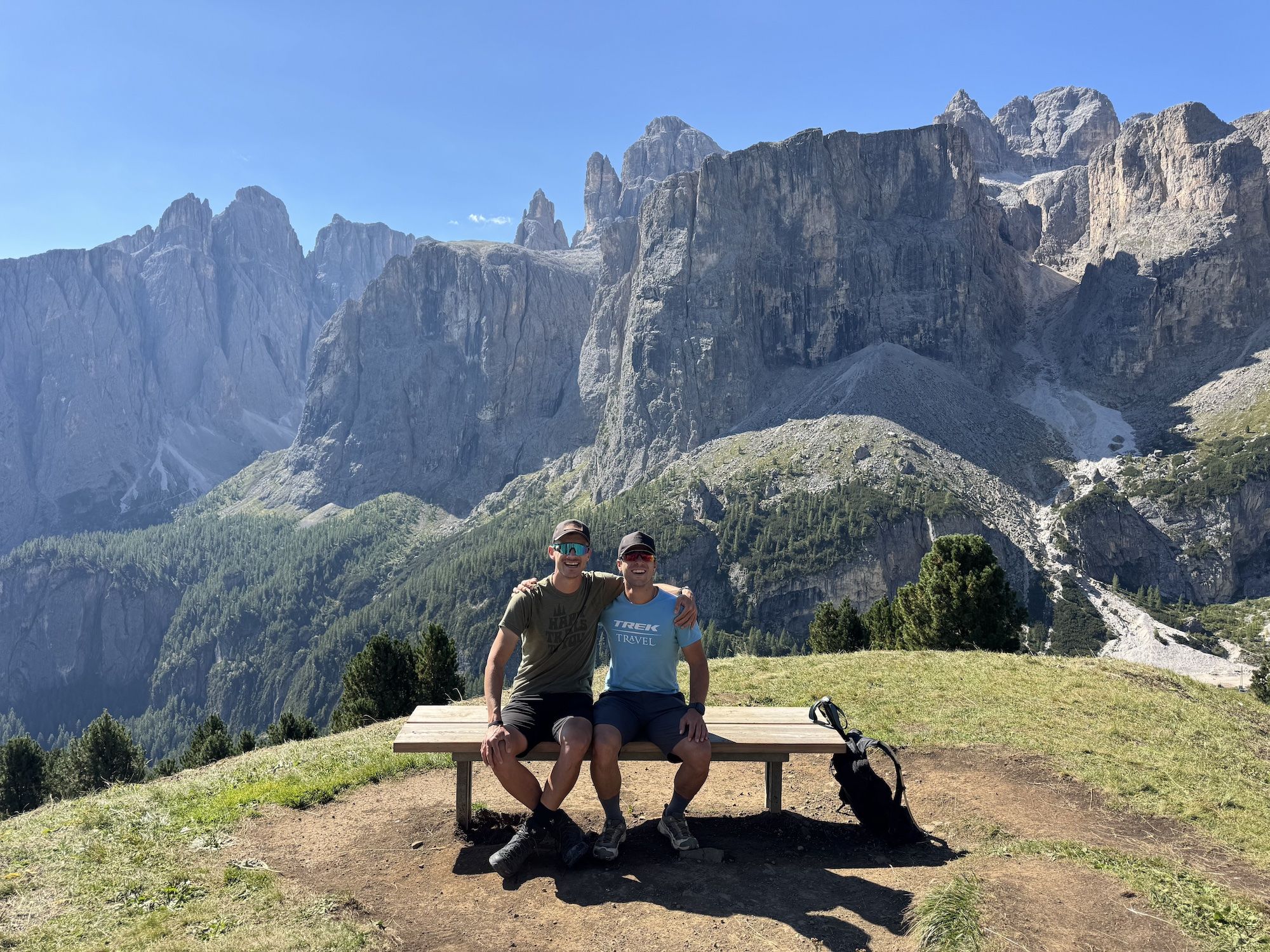
Morning in the Dolomites starts with a cable car climbing into thin alpine air, then the soft give of a meadow trail underfoot and the chalk-white towers of a UNESCO World Heritage range rising on every side. By midday you are eating lunch at a mountain rifugio with the Sassolungo massif filling the window. This is what a guided hiking and walking tour can be when the route, the hotels, and the logistics are handled by people who do it for a living. Trek Travel runs trips like this across eight destinations, from Italian peaks to Irish coastlines to the Pacific shore of Costa Rica, and what sets it apart starts with where the company came from.
A cycling company’s approach to hiking
Most guided hiking companies began life as hiking or adventure-trekking specialists. Trek Travel did not. It was founded by Trek Bicycle and made its name as a world leader in cycling vacations, planning fully supported active trips down to the smallest logistical detail. When it brought that same discipline to walking, the result was a different kind of hiking tour, one built by people who had already spent years perfecting routes, support vehicles, guide training, and hotel partnerships on the road.
That heritage shows up in the details. The routes are scouted and sequenced with the precision of a company used to mapping daily distances and elevation for riders. The support model, with a van meeting the group or shadowing the route, comes straight from the cycling playbook. But Trek Travel today is more than a bike-tour company. It has grown into a full active travel company, with hiking and walking tours, multi-adventure trips, and self-guided options sitting alongside its cycling vacations. That breadth was recognized in 2025, when Trek Travel was named one of Travel + Leisure’s World’s Best Tour Operators, with the magazine describing it as a cycling and hiking operator. For travelers who already know Trek Travel from a bike trip, or who want a single trusted operator for both cycling and hiking vacations, that continuity is the whole point. You are not gambling on a new company; you are walking with the same expertise that built one of the most respected names in active travel.
What every Trek Travel hiking and walking tour includes
Every tour is fully guided and supported by one or two certified guides who know the local trails, restaurants, and history. On the trail a guide stays with the group, and depending on group size a second guide either walks alongside or meets everyone at the end with the van. Off the trail, guides handle the details, from booking a massage to tracking down a regional specialty a guest has been hoping to try.
The inclusions are comprehensive in a way that removes friction from the trip. Trek Travel covers nightly accommodation at handpicked hotels, the meals listed in each itinerary, snacks and drinks on the trail, all luggage transfers and in-trip transportation, entrance fees for scheduled activities, and every gratuity for drivers, local experts, and hospitality staff. Hiking poles are available to borrow, and guests leave with a digital photo album of the week. Hotels come in three tiers, Luxury, Explorer, and Comfort, so travelers can match the lodging to their style without leaving the curated experience.
Where Trek Travel hikes
The collection spans Europe’s mountains and coastlines, the British Isles, and Latin America. You can browse the full set on the Hiking & Walking tours page, but here is the shape of it.
In the Alps, the Dolomites Hiking & Walking Tour is the flagship, a lodge-to-lodge route through Val Gardena and Alta Badia that crosses Alpe di Siusi, the highest mountain pasture in Europe, and finishes near the WWI tunnels of the Lagazuoi. The French and Italian Alps Hiking & Walking Tour covers the high alpine border country for travelers who want serious mountain terrain.
Along the Mediterranean, the Tuscany and Cinque Terre Hiking & Walking Tour pairs Chianti’s vineyard lanes with the cliffside trails connecting the five villages of the Cinque Terre, a UNESCO World Heritage Site. The Croatia Hiking & Walking Tour follows the Dalmatian coast and its islands, while the Portugal Hiking & Walking Tour threads the country’s rugged shoreline and inland trails.
In the British Isles, the Ireland Hiking & Walking Tour and England Hiking & Walking Tour cover green coastal country shaped by storied villages and dramatic cliffs.
Farther afield, the Costa Rica Hiking & Walking Tour moves through cloud forests and coastal trails alive with wildlife.
How to choose the right trip for you
The most common misconception about active travel is that you need to be an athlete to enjoy it. Trek Travel rates every trip on a four-level activity scale, and the numbers make the commitment clear before you book. Use them as a decision guide.
Choose a Level 1 tour if you want unhurried days of one to three hours on your feet, up to five miles, and no more than a thousand feet of climbing. This is the territory of coastal and village walks where the point is the scenery, the food, and the pace, not the exertion. Choose Level 2 if you are comfortable with four hours and four to eight miles a day. Step up to Level 3 if you are a regular hiker ready for three to five hours on the trail, six to ten miles, and up to two thousand feet of ascent. Reach for Level 4 only if you are an avid hiker who wants seven to fifteen miles a day and serious elevation. The full breakdown lives on the activity levels page.
This scale is also the clearest way to understand the difference between a walking tour and a hiking tour. The coastal and countryside trips sit toward the gentle end, where days are about villages, vineyards, and views. The alpine trips sit at the demanding end, where the reward is high mountain terrain that asks something of your legs. Cinque Terre, Tuscany, Portugal, and Ireland anchor the accessible end of the range; the Dolomites and the French and Italian Alps anchor the challenging end.
Fitness is not the only variable. If you are traveling with someone who would rather not hike every day, choose a destination that offers non-hiker options. On the Tuscany and Cinque Terre tour, a guest can lounge on a private beach or explore a town instead of walking; Ireland and Portugal are similarly flexible. The Dolomites tour is the clear exception, where remote trailheads and mountain terrain leave few alternatives, so Trek Travel openly steers non-hikers toward the more accommodating destinations rather than overpromising.
When to go
Timing follows the terrain. The high alpine trips in the Dolomites and the French and Italian Alps run in summer, when the trails are clear of snow and the mountain huts are open for lunch. The Mediterranean and coastal destinations, Cinque Terre, Tuscany, Croatia, and Portugal, are at their best in late spring and early fall, when daytime temperatures are mild and the famous trails are quieter than in peak summer.
Why travelers choose Trek Travel for hiking and walking
A good walking vacation is defined by what you do not have to think about. With certified guides, handpicked hotels, every gratuity and transfer handled, and a clear activity scale to match a trip to your fitness, Trek Travel takes the planning off your plate so the destination can have your full attention. The expertise that built a leading cycling-tour company now stands behind every trail.
Find the trip that fits you on the Hiking & Walking tours page, or talk through the options with a Trek Travel trip consultant.
Frequently Asked Questions
How hard is hiking in the Dolomites?
It varies widely. The Dolomites offer everything from gentle meadow loops of two to three miles to steep, exposed mountain paths with significant climbing at medium to high altitude. Many of the most scenic routes involve narrow trails and prolonged descents, so being sure-footed and in good condition helps. Cable cars and chairlifts make some high terrain accessible without a full climb, which is part of what makes the region work for a range of fitness levels.
When is the best time to hike the Dolomites?
The prime hiking season runs from late June or early July through mid-September, when high-altitude trails are clear of snow and the mountain rifugios are open. July and August are the warmest and busiest months, with temperatures from about 73 to 86 degrees Fahrenheit depending on elevation. Many experienced hikers prefer early September for clear trails, cooler air, and thinner crowds. Mountain weather changes fast in any season, so layers and rain gear are essential.
Which valleys are best for hiking in the Dolomites?
Val Gardena and Alta Badia are two of the most celebrated bases. Val Gardena puts you near Alpe di Siusi, the highest mountain pasture in Europe, and the UNESCO-listed peaks of Alpe Seceda. Alta Badia, around the village of Corvara, gives access to the Pralongia plateau and trails beneath the Sassongher mountain. Both connect to the Lagazuoi and Cinque Torri area, known for its open-air WWI museum of tunnels and fortifications.
What is included on a Trek Travel hiking and walking tour?
Trek Travel hiking and walking tours include nightly accommodation at handpicked hotels, the meals listed in each itinerary, one or two certified guides, daily route support, snacks and drinks on the trail, all luggage transfers and in-trip transportation, entrance fees for scheduled activities, and all gratuities for drivers, local experts, and hospitality staff. Hiking poles are available to use on trip, and guests receive a digital photo album afterward.
How fit do I need to be for a guided walking tour?
It depends on the trip you choose. Trek Travel’s Level 1 tours involve up to three hours of walking and no more than five miles a day on gentle terrain, while Level 4 tours can involve seven to fifteen miles a day with significant elevation gain. Because each tour is rated on this scale, travelers can match a trip to their fitness and experience rather than assuming all walking vacations are the same.
What is the difference between a hiking tour and a walking tour?
The terms describe a spectrum rather than two separate products. On a Trek Travel trip, walking generally refers to shorter, gentler routes on even terrain, often linking villages, vineyards, or coastlines, while hiking refers to longer days on mountain trails with more climbing and uneven ground. Trek Travel’s four activity levels make the distinction concrete, so a Level 1 coastal walk and a Level 3 alpine hike are clearly different commitments.
When is the best time to take a hiking tour in Europe?
The ideal season depends on the destination. Alpine tours in the Dolomites and the French and Italian Alps run in summer, roughly July and August, when the high trails are clear and the mountain huts are open. Mediterranean and coastal destinations such as Cinque Terre, Tuscany, Croatia, and Portugal are most pleasant in late spring and early fall, when temperatures are mild and the trails are less crowded.
Can my partner come if they don't want to hike every day?
On many Trek Travel trips, yes. Destinations including Cinque Terre, Tuscany, Ireland, and Portugal offer non-hiker options and activities for guests who want to take an afternoon off or spend little time on the trail. The Dolomites tour is an exception, as the terrain and remote trailheads leave few non-hiker options, so Trek Travel discourages non-hikers from that itinerary specifically.
Why choose Trek Travel for a hiking and walking tour?
Trek Travel was founded by Trek Bicycle and built its reputation on meticulously planned, fully supported active vacations. It brings that same logistics expertise to hiking, with certified guides, three hotel tiers to match different styles, all gratuities and luggage transfers handled, and a four-level activity system that helps travelers choose the right trip. The result is a walking vacation where the planning is taken care of and the focus stays on the destination.


